This podcast video is currently under construction.
From the food we eat to the products we rely on daily, the things we use start in one of our vessels. For over a century, our teams have worked on projects that make necessities possible, building the things that make real life work. By introducing new capabilities, innovative processes, and facilities, we can fabricate more efficiently to save our customers time and money and offer you a single-source solution. Over our history, one thing remained paramount—our commitment to fabricating and producing lasting, trusted equipment.
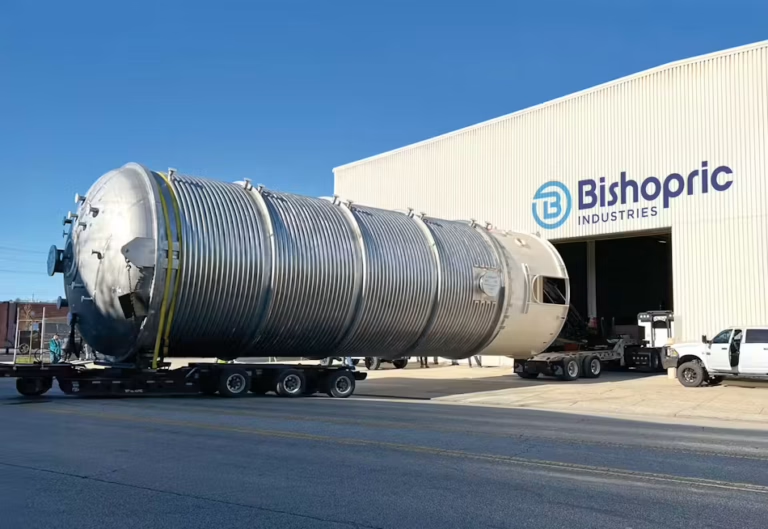
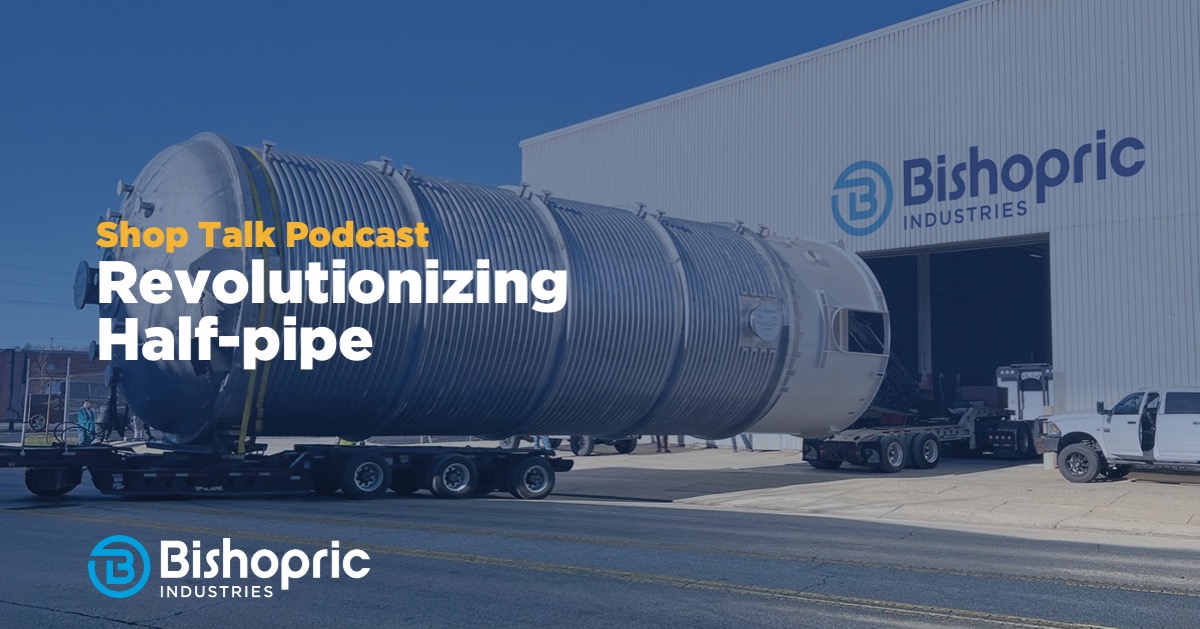
In this third episode of Shop Talk, we discuss all things half-pipe, from jackets and reactors to welding techniques and everything in between.
🔍 In this episode, we cover:
- How half-pipe jacketed reactors excel at cyclical service where a process rapidly switches between heating and cooling.
- How thinner, more cost-effective vessels walls are possible because half-pipes do not add external pressure to design calculations.
- How half-pipe jackets are heavily used on chemical and petrochemical reactors to initiate catalyst reactions and to cool intense heat.
- That half-pipe is a better choice for aggressive utility wear over dimple jackets, which can crack in high-pH environments.
- That half-pipe jackets are more complex but enable thinner walls than conventional jackets.
- That using 6-inch (130-degree) half-pipes increases heat transfer by up to 20% while cutting welding labor.
- Fabricating with continuous coils eliminates butt joints, the primary failure point in older half-pipe designs.
- That full-penetration welds are recommended when the temperature in the process changes more than 250°F because they eliminate internal crevices to prevent stress corrosion cracking.
- That with real-time laser tracking and automated systems, modern shops can weld both sides of the half-pipe simultaneously.
- That installing half-pipes on complex vessel heads and knuckle radiuses requires highly precise, manual layout to avoid thermal stress.
Interested in how the workhorse of many chemical synthesis processes are made? This episode gives you insight from seasoned professionals on how they work, how innovation is revolutionizing performance, and how we build half-pipe jacketed reactors to go the distance.